Content Marketing Strategy That Drives Real Conversions
Content frameworks that move users from awareness to action. Stop writing for pageviews and start writing for pipeline.
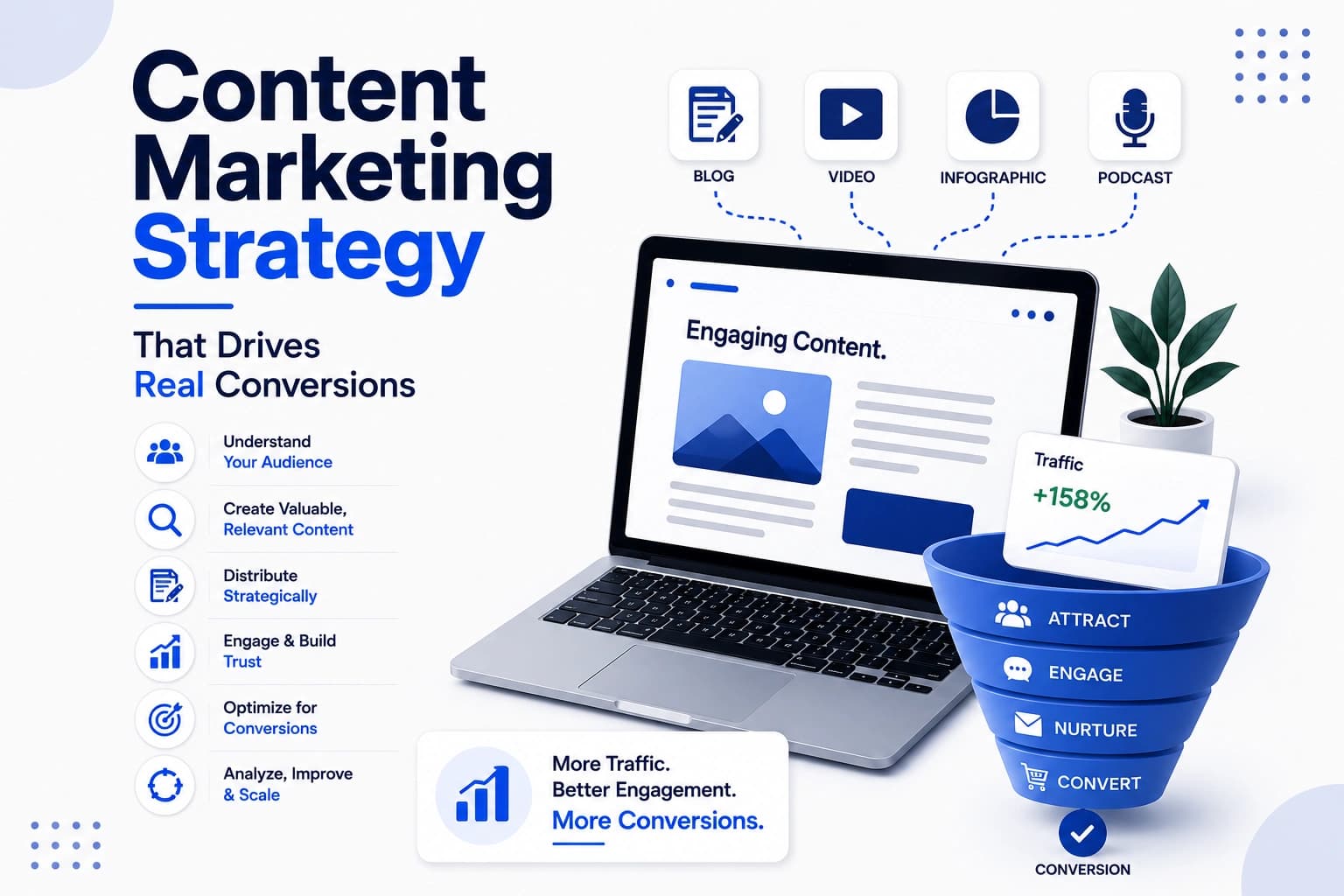
What is a conversion-focused content marketing strategy? A conversion-focused content strategy is a framework designed to move prospects through a defined funnel—from initial awareness to final purchase—by aligning specific content formats (like blogs, case studies, and calculators) directly with the buyer's intent at each stage.
Key takeaway: Stop optimizing for generic pageviews. Instead, prioritize content distribution over creation, match your formats to the buyer's journey (TOFU, MOFU, BOFU), and measure success by pipeline generated rather than vanity metrics. Content is a product that requires a clear UX and iteration.
Target Audience & Use Case: Tailored for growth marketers, founders, and content leads in B2B and SaaS who need to shift their marketing efforts from brand awareness to measurable revenue generation.
Content is the engine of modern marketing. It moves the prospect from "I don't know who you are" to "I need this product right now." However, most startups treat content like a checklist, churning out generic blog posts that generate zero pipeline.
True content marketing isn't about volume; it is about relevance, distribution, and engineering a clear path to conversion. If a piece of content doesn't educate, agitate a pain point, or build unbreakable trust, it is a waste of your runway. According to B2B research by the Content Marketing Institute, over 70% of the most successful marketers rely on a documented strategy rather than ad-hoc publishing.
This guide breaks down how to build a full-funnel content strategy that captures attention, nurtures leads, and drives measurable revenue for your startup.
Content Principles
Content is a product
Treat your content with the same rigor as your software. It needs a target audience, a clear UX, and an iterative feedback loop based on usage.
Distribution first
Spending 8 hours writing and 0 hours distributing is a recipe for zero traffic. Spend 20% of your time creating, and 80% amplifying.
Intent drives format
Match the format to the buyer's journey. A short TikTok builds awareness; a 5,000-word whitepaper validates a B2B purchasing decision.
How to conduct audience research and messaging?
You cannot write high-converting content if you don't know exactly who is reading it. Talk to your best customers and document their exact phrasing.
Identify the "status quo" your audience accepts today, and agitate the pain points associated with it.
Create detailed buyer personas. A developer reading API docs needs vastly different messaging than a CFO reading a pricing guide.
What are the best editorial standards and workflows?
Establish a brand voice and tone guide. Whether you use in-house writers or freelancers, the output must sound like a cohesive brand.
Use a centralized editorial calendar (Notion or Airtable) to track pieces from ideation to drafting, review, and publication.
Build a rigorous review process to ensure absolute technical accuracy.
Which formats move the pipeline?
Top-of-funnel (TOFU): High-level guides, social media threads, and short-form videos designed purely to capture attention and solve broad problems.
Middle-of-funnel (MOFU): Webinars, templates, and deep-dive case studies that prove your expertise and capture email addresses.
Bottom-of-funnel (BOFU): ROI calculators, competitor comparison pages (e.g., "Us vs. Competitor X"), and sandbox demos that close deals.
How to master distribution and repurposing?
Never publish and pray. Every piece of core content needs a 14-day distribution runway across email, social, and communities.
The Repurposing Engine: Turn one 45-minute podcast into a long-form blog post, 5 LinkedIn carousels, and 10 short-form clips.
Leverage your team's personal networks to amplify company content organically.
How to measure and optimize content?
Pageviews are a vanity metric. Track pipeline generated, Marketing Qualified Leads (MQLs), and newsletter subscriber growth.
Use multi-touch attribution if possible to see how content assists sales calls.
Regularly audit and update old content. Refreshing a post from last year is often faster than writing a new one from scratch.
◆ Execution blueprint
Phased timeline to build a high-ROI content marketing engine.
| Phase | Goal | Output | Timeline |
|---|---|---|---|
| Audit | Find content gaps | Topic cluster map | Week 1 |
| Plan | Set editorial themes | Content calendar | Week 2 |
| Create | Write/Record assets | V1 Drafts & Media | Weeks 3-4 |
| Distribute | Amplify the reach | Social & Email blasts | Ongoing |
| Review | Measure conversions | Analytics report | Monthly |
Reference table
| Funnel Stage | Asset Type | Primary KPI |
|---|---|---|
| Top (Awareness) | Blog posts, Social videos | Traffic, Impressions |
| Middle (Consideration) | Ebooks, Webinars, Newsletters | Opt-ins, Lead Capture |
| Bottom (Decision) | Case Studies, Pricing pages | Demo requests, Sales |
| Post-Sale (Retention) | Help center, Product updates | Churn reduction, NRR |
Key points
- Every piece of content must have a clear Call to Action (CTA).
- Quality drastically outperforms sheer volume.
- Speak to the pain, not just the product features.
- Build a distribution checklist for every new post.
- Competitor comparison pages convert at massive rates.
- Repurpose everything; never use an asset just once.
- Use customer quotes and real data to build authority.
- Don't gate top-of-funnel content; let it spread.
- Case studies are your most valuable sales enablement tool.
- Update high-performing old content to maintain rankings.
Action checklist
- Interview 5 customers for exact phrasing
- Document your style and tone guide
- Create a 3-month editorial calendar
- Draft one high-value "Pillar" asset
- Set up an email capture form on the blog
- Write your first customer case study
- Create a "Competitor Alternative" page
- Build a content distribution checklist
- Set up Google Analytics conversion goals
- Schedule a quarterly content refresh audit
Frequently asked questions
Quick answers to what founders usually ask about content.
How long until I see ROI from content?
If relying strictly on SEO, it can take 3 to 6 months to see compounding traffic. However, if you actively distribute your content via social media, outbound sales emails, and targeted communities, you can see leads and conversions within the first week of publishing.
If relying strictly on SEO, it can take 3 to 6 months to see compounding traffic. However, if you actively distribute your content via social media, outbound sales emails, and targeted communities, you can see leads and conversions within the first week of publishing.
Should we gate our content?
Gate bottom-of-funnel content (like templates, deep-dive reports, and webinars) where the user has high intent. Leave top-of-funnel content (like blog posts and how-to guides) ungated to maximize reach, SEO, and brand awareness.
What about AI-generated content?
AI is great for outlining and overcoming blank-page syndrome. However, purely AI-generated content lacks the unique perspective (E-E-A-T) Google requires to rank, and it fails to build real trust with readers. Use AI for structure, but humans for insight.
Should founders write the content?
In the beginning, yes. Founder-led content carries a level of authenticity and subject-matter expertise that a freelance writer cannot replicate. As you scale, you can hire editors to interview the founder and turn their raw insights into polished posts.
How long should a blog post be?
As long as it needs to be to thoroughly solve the user's problem, and not a word longer. Word count is not a ranking factor; search intent satisfaction is. A dense, highly actionable 800-word post beats a fluffy 3,000-word essay every time.
Can MYSTARTUPWAVE manage our content pipeline?
Yes. We help startups define their content pillars, build high-converting landing pages, and create SEO-driven content frameworks that align perfectly with their overarching growth strategies.
Need implementation support?
MYSTARTUPWAVE helps founders and teams ship product, growth, and cloud delivery with clear milestones.